Music performed by the open internet. A Composition fixes only the harmony, the bars and the tempo shape. A Performer, often an agent a person sends, realizes it from openly licensed sound: registered Suppliers first, then the open commons, found with any discovery tool (the NetComposer crawler is one). Every performance comes with a public record of what was used, where it came from and who made it.
Four roles make it work. Anyone can take any of them.
What People and sites that make sound and share it under an open license.
Why A Performer has no instrument of its own. The open sound commons is the instrument, and Suppliers build it.
Take part
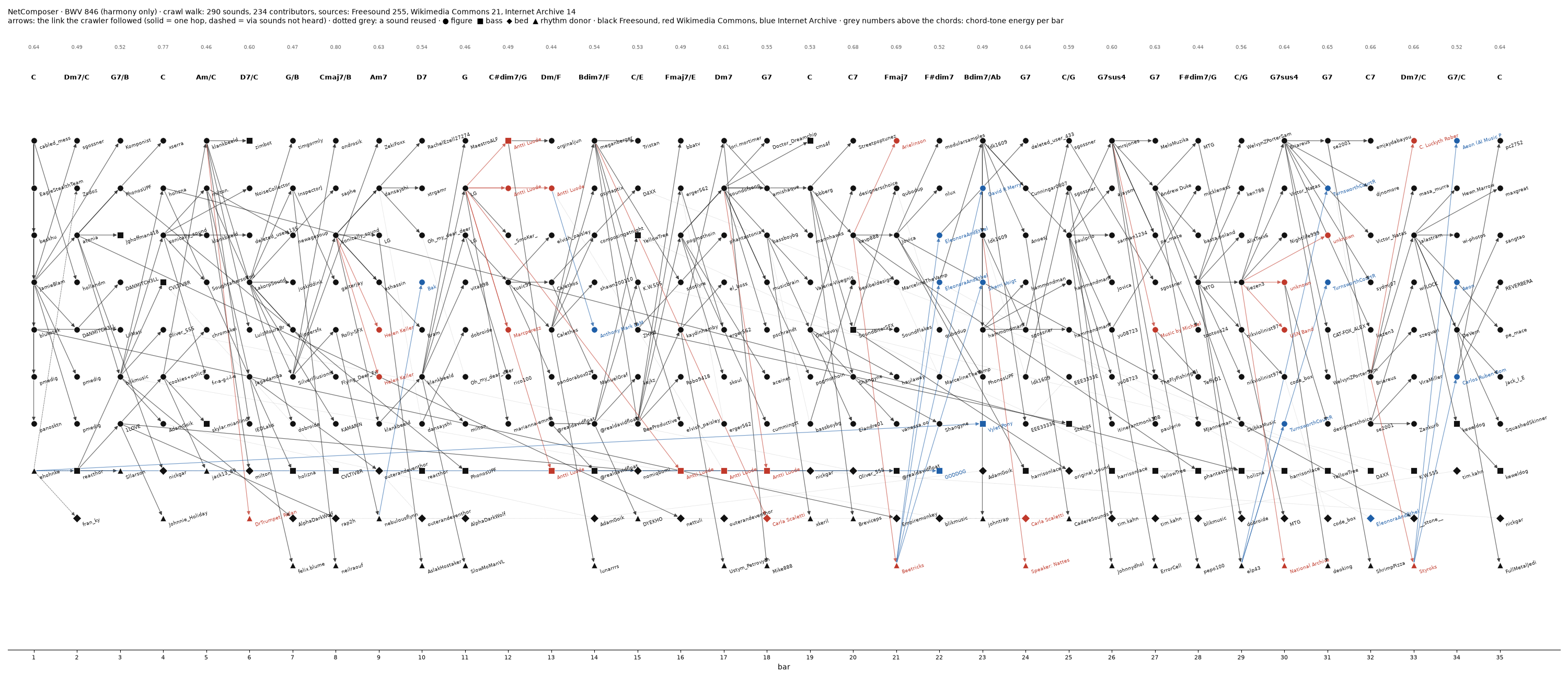
Publish audio under CC0, CC BY, CC BY-SA or public domain anywhere an agent can reach it. Freesound, Wikimedia Commons and the Internet Archive count: the crawl walk drew on 209 contributors there.
Better: publish a netcomposer.json index with a manifest per sound, as musicmatter.art does, and register it.
Registered Suppliers are listed in suppliers.json, where agents look first, and will be checked (licenses and checksums) on every validation run. Today the registry is checked with the validator. Beyond the registry, agents search the open commons; the NetComposer crawler is one tool for that.
Every record that uses your sound credits you by name, with a link.
“Music’s structure can be described mathematically. There is art in the math, and there is art in the performance. NetComposer is my exploration of that duality.”
How they interact
SUPPLIERS -- open sound (CC0 / BY / BY-SA / PD) --> DISCOVERY
  ^   suppliers.json first; crawler is one tool         |
  |                                                     | found sound
  |                                                     v
  |   COMPOSERS -- Composition ------------------> PERFORMERS <-- hacks
  |                                                     |
  |                                                     | performance + record
  |                                                     v
  +-- each record credits every Supplier ---------- AUDIENCE
                                             listen / share / remix
Suppliers publish sound; Performers and the agents people send find it, in suppliers.json first and then the open commons, with any discovery tool (the NetComposer crawler is one). A Composer’s plan and the found sound meet in a Performer, whose choices produce the performance and its record. The Audience gets both, and the record credits every Supplier whose sound was used, with a link back. One person can play every role, or thousands of strangers can.
The record
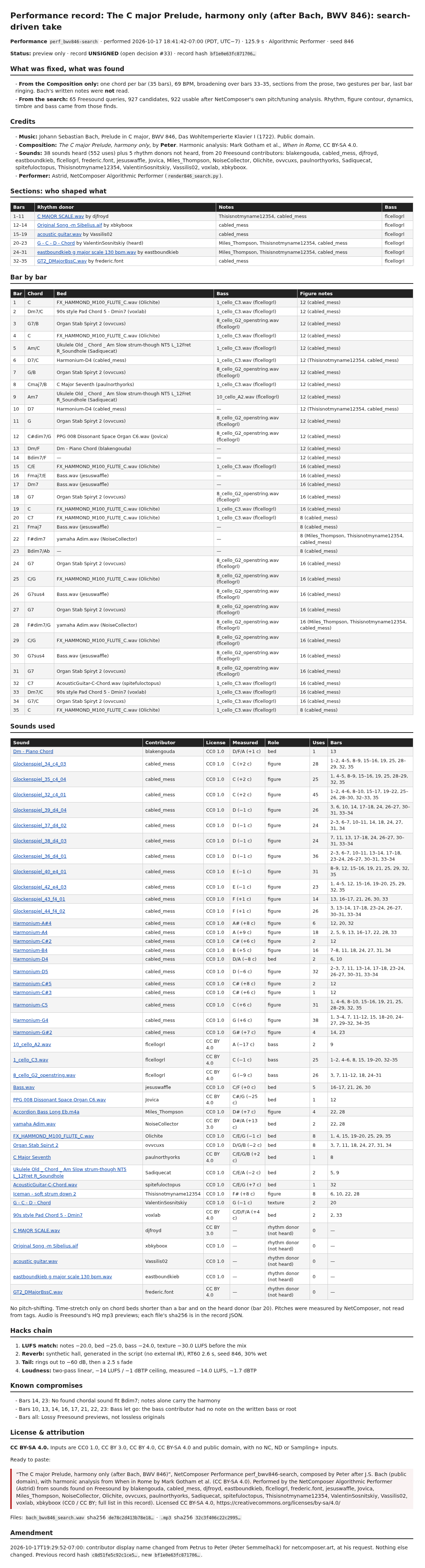
Each performance carries an exact account of itself: every sound, its contributor, license, source URL and checksum, where it was placed in the piece, every Performer setting and the seed. CC BY requires credit anyway. The record makes credit exact rather than a footnote.
Recorded music has mostly been a sealed artifact. Sample-level credit is rare and usually private. Here credit, provenance and method travel with the music, in public, readable by people and agents. The Composition is the score of the piece; the record is the score of the performance.
What it makes possible:
Reproduction: the inputs (with checksums), every setting and the seed are enough to rebuild a performance exactly.
Forks: change one setting or swap one Supplier, and the new record shows exactly what changed.
Supplier view: Suppliers can see where their sounds were used. A usage view built from records is in draft for musicmatter.art.
Comparison: performances of one Composition can be compared sound by sound and setting by setting.
The crawl path as artwork: the walk record traces every hop from the seed sound, drawn as a path chart.
Agents: agents can read, audit and build on any performance from the raw JSON.
Signed records, later: records are unsigned for now. Signing is open decision #33.
Peter’s Notarism is about witnessing and recording existence. The record is NetComposer’s act of witness.
How a record is built, with annotated excerpts from the walk performance: /record/.
One Composition, four Performances
The C major Prelude, harmony only (after Bach, BWV 846). Composed by Peter from the When in Rome analysis (CC BY-SA 4.0). One chord per bar, 35 bars, 4/4, 69 BPM, broadening over bars 33–35. No notes, no timbres. Composition text.
Chord strikes from musicmatter.art, two per bar. Each strike also plays reversed, swelling into the next. Hall 40%, 24 dB/oct low-pass swept 500 Hz → 20 kHz → 600 Hz.
2:06 · 28 chord recordings by Peter (musicmatter.art) record: read · json · md
2. Take 6 · arps, 1/4 delay, LP 1 kHz
Up/down arpeggios from musicmatter.art, time-stretched to the half bar. 1/4 delay 40% fb, hall 25%, LP 1 kHz 24 dB/oct.
2:09 · 26 arpeggio recordings by Peter (musicmatter.art) record: read · json · md
3. Search-driven take
Only the chords are fixed. Rhythm and figure contour come from the onsets of sounds the crawler found; notes, beds and bass are found sounds (no pitch-shift). Hall 30%.
The timbre travels. Each bar's sounds were found by following links from the previous bar's: similar sounds, tags, packs, users, then out to Wikimedia Commons and the Internet Archive. Rhythm rotates with them. Only the chords are fixed. Hall 30%.
Today the Performer draws on one registered Supplier, musicmatter.art, plus open libraries: Freesound, and in the crawl walk also Wikimedia Commons and the Internet Archive. The wider Supplier network is the ambition. The Supplier registry has one entry. Inputs must be CC0, CC BY, CC BY-SA, or public domain; never NC, ND, Sampling+, or custom licenses. Time-stretch is allowed; pitch-shifting is not. The record format is a draft, and records are unsigned for now.
First Supplier: musicmatter.art
musicmatter.art by Peter Semmelhack is the first NetComposer Supplier and entry #1 in the registry: 1,356 lossless sounds (FLAC, 24-bit/48 kHz), 702 chord strikes and 654 up/down arpeggios, across 12 roots and 9 qualities (maj, min, 7, maj7, m7, dim, dim7, aug, sus4), in multiple takes. License: CC BY-SA 4.0.
Machine-readable: an index at musicmatter.art/netcomposer.json lists every sound with its FLAC and a per-sound manifest (/sounds/<name>.nc.json: chord, register and bass, format, sha256, license). The Supplier spec documents these fields.
How the Performer uses it: it reads the manifests, picks one sound per bar whose chord matches the Composition, prefers the one whose lowest note is the written bass and whose register sits close to the previous bar, then trims, layers or time-stretches it (never pitch-shifts). Performance 1 uses 28 chord strikes; performance 2 uses 26 arpeggios. Both were read from a local copy of the site, and the audio used is sample-identical to the published FLACs. Performances 3 and 4 do not use it: 3 draws on Freesound, 4 on Freesound, Wikimedia Commons and the Internet Archive.
License and credits
All performances and the Composition are licensed CC BY-SA 4.0.
Music: Johann Sebastian Bach, Prelude in C major, BWV 846 (1722). Public domain.
Harmonic analysis: Mark Gotham et al., When in Rome, CC BY-SA 4.0.
Composition: Peter.
Sounds: Peter (musicmatter.art), CC BY-SA 4.0, performances 1 and 2.